Choice Overload: Why 24 Options Are Worse Than 6
More choice feels better and performs worse. Jam proved it.
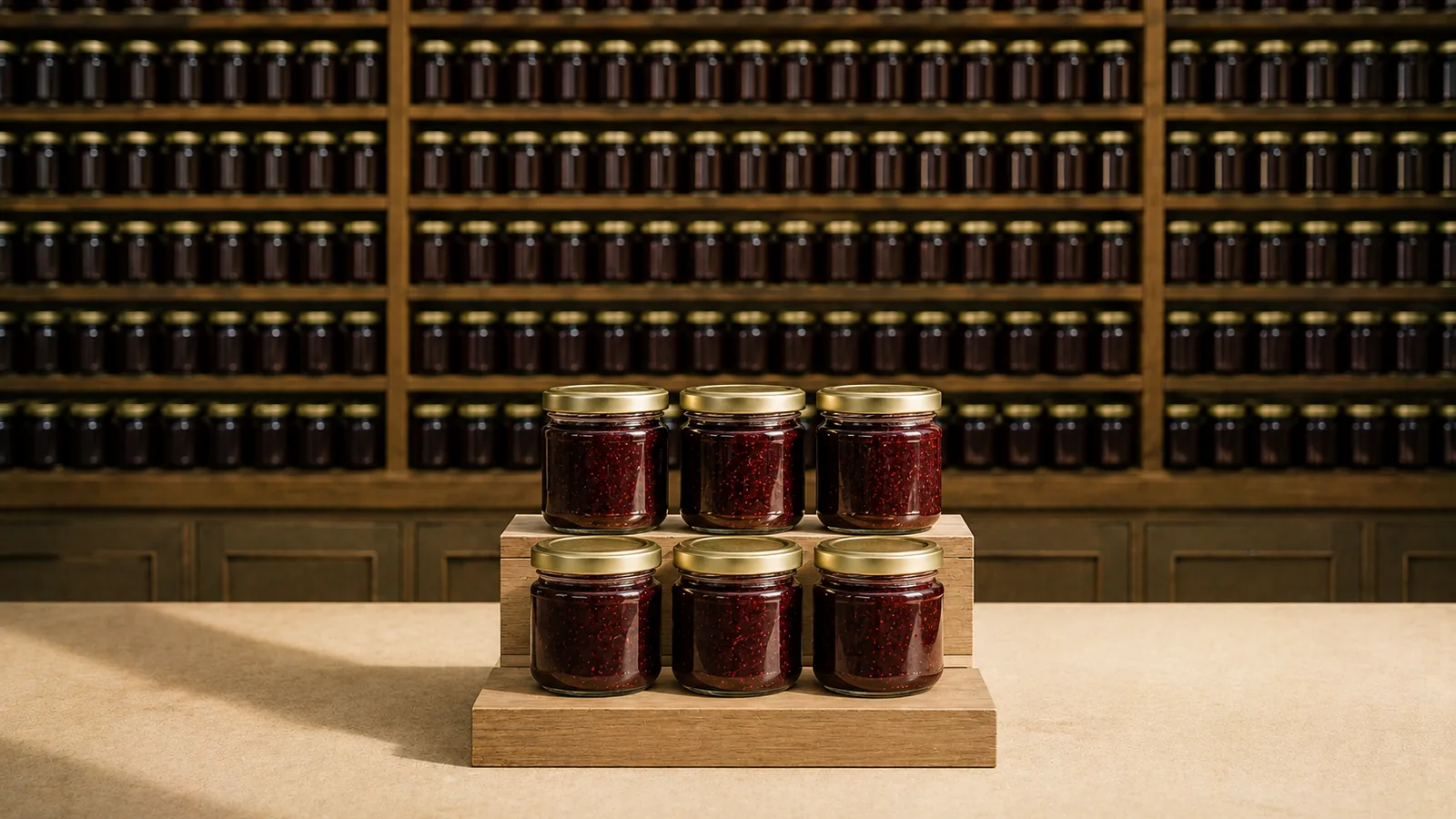
The jam study is one of the most cited experiments in consumer psychology: a display of 24 jams drew more browsers than one of 6, but far fewer buyers. It is also one of the least reliably replicated. A 2010 meta-analysis of around 50 papers found an average effect of essentially zero, and a direct replication of the jam study itself found nothing. A later meta-analysis recovered the effect — but only under four specific conditions.
The honest version of this topic is not "choice overload is real" or "choice overload was debunked." It is that the question "does more choice hurt?" turns out to be badly formed, and the useful question is when.
The original study
Sheena Iyengar and Mark Lepper published "When choice is demotivating" in 2000. In the best-known of their studies, a tasting booth in an upmarket Californian grocery store displayed either 6 or 24 varieties of jam on rotation.
The large display attracted more attention — around 60 percent of passing shoppers stopped, against roughly 40 percent for the small one. The purchase figures went the other way, and dramatically: about 30 percent of those who stopped at the small display bought jam, against about 3 percent at the large one.
It is a genuinely elegant field experiment with real shoppers spending real money, and the counterintuitive result travelled fast — into business books, TED talks, and a broad cultural idea that abundance of choice is paralysing.
What happened when people looked
In 2010 Benjamin Scheibehenne, Rainer Greifeneder and Peter Todd published a meta-analysis in the Journal of Consumer Research covering around 50 papers and 63 experiments.
The mean effect size across the literature was, in their phrase, virtually zero. Some studies found choice overload, some found the opposite — that more options improved outcomes — and the two roughly cancelled. They also documented evidence of publication bias: successful demonstrations appeared to be published preferentially over failures, which would inflate the effect in any narrative reading of the field.
Scheibehenne also ran a direct replication of the jam study. It found no significant choice overload effect. An attempt to replicate a related chocolate study produced similarly contradictory results.
The pushback, which had a point
Defenders argued that the meta-analysis pooled studies testing different constructs, that some were mis-operationalised, and that laboratory studies with students may systematically under-detect an effect that appeared in a real store with real shoppers. These are reasonable objections rather than special pleading.
The reconciliation
In 2015 Alexander Chernev, Ulf Böckenholt and Joseph Goodman published a second meta-analysis in the Journal of Consumer Psychology, covering 99 experiments across 53 papers, and asked a different question: not whether the effect exists on average, but what determines when it appears.
They identified four moderators. Choice set complexity — how difficult the options are to compare. Decision task difficulty — time pressure, cognitive load, the format of presentation. Preference uncertainty — whether you already know what you want. And decision goal — whether you are trying to minimise effort rather than optimise the outcome.
When these conditions are present, choice overload appears reliably and substantially. When they are absent, larger assortments are neutral or actively helpful. The average across a literature mixing both situations is close to zero, which is exactly what the earlier meta-analysis found — and which turns out to be a statement about the sample of studies rather than about people.
This is a much better outcome than either camp winning. Note the contrast with the neighbouring finding in this hub: the IKEA effect went through the same process and emerged with a solid moderate effect size. Fame and evidence are independent variables.
What this predicts
The moderators translate into fairly specific expectations.
- An expert with clear preferences is helped by a large assortment. A sommelier is not overwhelmed by a long wine list.
- A novice with no established preference, choosing between hard-to-compare options under time pressure, is the classic overload case — pension funds and health plans are the standard real-world examples.
- Options that differ on a single easily ranked attribute cause little difficulty however many there are.
- Someone browsing to satisfy curiosity behaves differently from someone who has come to buy, which is part of why the jam booth produced the pattern it did.
The practical advice that follows is not "offer fewer options." It is to reduce comparison difficulty — good filtering, sensible defaults, clear differentiation between options — which addresses the moderators directly rather than restricting the assortment.
The real-world case that survives
One field finding is worth separating from the laboratory dispute. Iyengar, Gur Huberman and Wei Jiang examined participation in American 401(k) retirement plans across hundreds of plans and hundreds of thousands of employees, and found that participation declined as the number of fund options increased.
This is the strongest practical case for choice overload, and it fits the moderator account precisely rather than contradicting it. Retirement funds are hard to compare, most employees have no established preference over them, the options differ on multiple attributes that cannot be lined up against each other, and the decision is one people are strongly motivated to defer. All four moderators, present at once.
It also shows why the effect matters where it does occur. A shopper who buys no jam has lost very little. An employee who defers enrolment for a decade has lost a great deal, and the deferral was produced by the structure of the choice rather than by any considered judgement.
Why the simple version persists
The paradox-of-choice framing is memorable, counterintuitive, actionable and flattering to the reader, and it arrived attached to a vivid image of a jam stall. The meta-analytic correction is none of those things: it requires holding four moderators in mind and answering most questions with "it depends."
This is a recurring shape in popular psychology. A real but conditional effect gets promoted to a general law, the qualifications drop away in retelling, and the law outlives the evidence that produced it. The same has happened to the finding that time accelerates as you age, which is real, narrow, and routinely described as though it were dramatic and universal.
Same trick, different system
Why Onions Make You Cry (and Why the Fridge Trick Works)
Frequently asked questions
A 2000 field experiment by Iyengar and Lepper in which a grocery store tasting booth displayed either 6 or 24 jams. The larger display attracted more browsers but produced far fewer purchases — roughly 3 percent against about 30 percent.
Inconsistently. A 2010 meta-analysis of around 50 papers found an average effect of essentially zero along with evidence of publication bias, and a direct replication of the jam study found no significant effect.
It is real under specific conditions. A 2015 meta-analysis of 99 experiments identified four moderators — choice set complexity, decision task difficulty, preference uncertainty, and an effort-minimising goal. Where these are present the effect is substantial; where absent, more options are neutral or helpful.
When you already know what you want, when options are easy to compare, when there is no time pressure, and when you are trying to optimise rather than to decide quickly. Expertise in the domain reliably reduces the difficulty larger assortments create.
Not necessarily. The evidence points at comparison difficulty rather than quantity, so better filtering, sensible defaults and clear differentiation address the underlying problem without cutting the range.
This article is educational science trivia about everyday human biology and psychology. It is not medical advice, diagnosis, or treatment, and it is not a substitute for care from a qualified professional.