The Doorway Effect: Why You Forget Why You Walked Into the Room
You didn’t forget. The doorway deleted it.
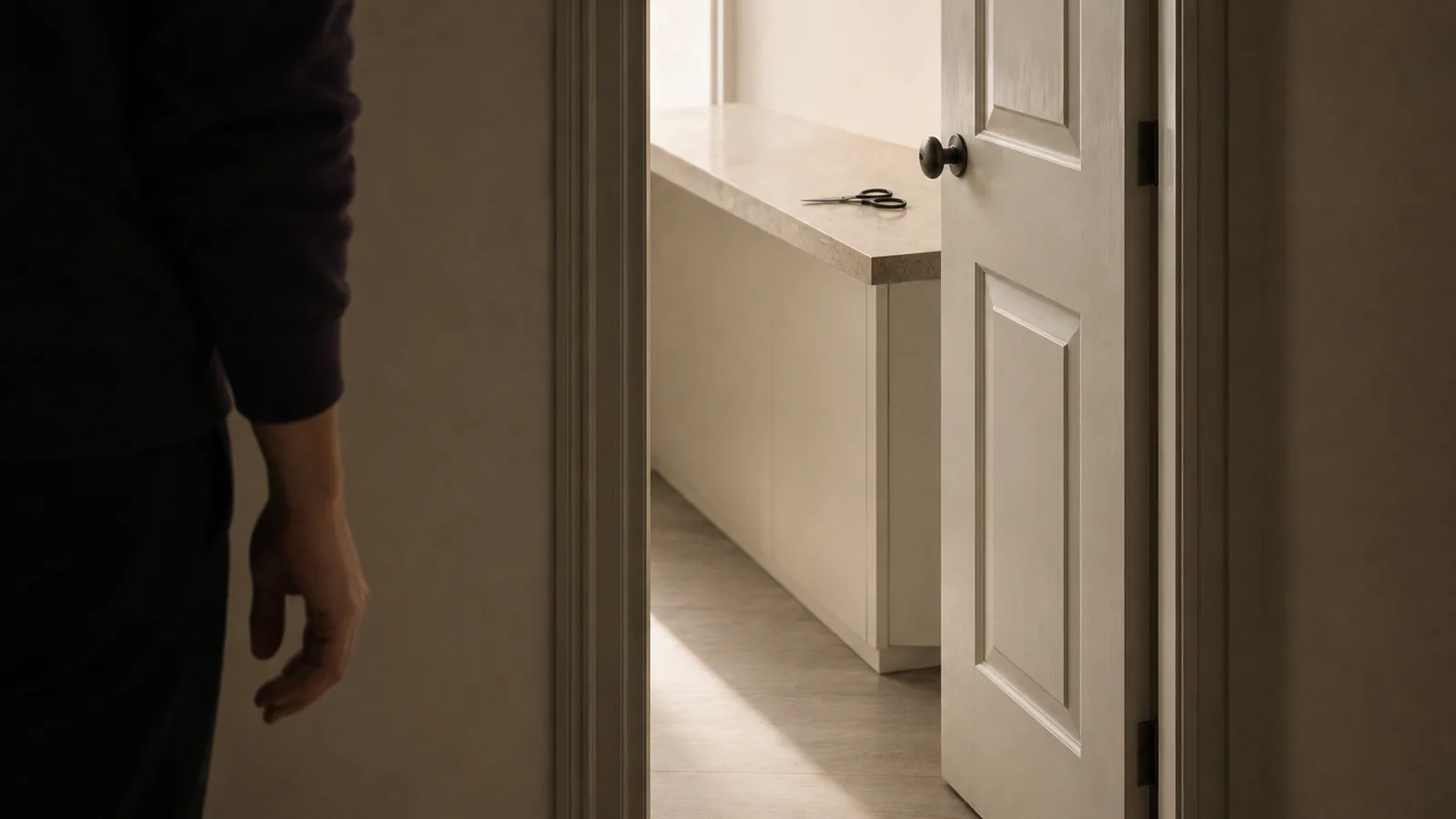
You walk into the kitchen with total clarity of purpose, cross the threshold, and the purpose evaporates. This is the doorway effect. Walking through a doorway acts as an “event boundary”: it closes the mental model of the room you just left and opens a new one, and the goal you were holding in working memory gets flushed out with the old model.
The relief in that explanation is that nothing has gone wrong. Your memory did not fail. It did exactly what it is designed to do — it just did it at an inconvenient moment.
What the doorway effect actually is
The doorway effect describes a narrow kind of forgetting: you lose an active intention at the moment you move from one location to another. It is not general absent-mindedness, and it is not the same as forgetting where you put your keys. The signature is the timing. The thought survives the decision, survives standing up, survives the walk — and then dies precisely at the threshold.
Researchers usually call this a failure of prospective memory: memory for things you intend to do, rather than things that have already happened. Prospective memory is expensive. Holding “get the scissors” active requires you to keep an unfinished goal live while you do something else entirely, like navigating a hallway and stepping over a dog.
The experiment that made doorways famous
The best-known work comes from Gabriel Radvansky's lab at the University of Notre Dame. Participants moved through a virtual environment, picking up an object on one table and carrying it to another, then being tested on what they were carrying. Sometimes the second table sat in the same room. Sometimes it was through a doorway.
Distance travelled was held constant. The only difference was the threshold. Memory was consistently worse after passing through a doorway than after covering the same distance within one room, and the team reproduced the result in real rooms with real boxes.
Later replication work found the effect is more fragile than the headlines suggested. It shows up strongly when people are already under cognitive load, and can vanish when the task is easy and attention is plentiful. Keep that nuance: the doorway is a reliable trigger, not an inescapable law.
Why a doorway, of all things
The explanation that fits best is event segmentation theory, largely associated with Jeffrey Zacks and colleagues. Your experience does not arrive as a continuous stream. Your brain chops it into discrete events, the way a film is cut into scenes.
Radvansky's original 2006 study ran in a virtual environment; the 2011 follow-up reproduced the effect in real rooms with real objects, and added the condition that killed the obvious folk remedy — participants who walked back through the doorway to where they started did not get a full recovery of memory. Reinstating the room helps, because the room supplies cues. It does not simply reopen the closed model.
The size of the effect depends heavily on how loaded you already are. A 2021 multimodal investigation found the doorway penalty appeared clearly when participants were under additional cognitive demand and could vanish when the task was easy and attention plentiful. That is a meaningful correction to the popular version, and it explains the everyday pattern: you lose the errand when you were also thinking about something else on the way.
At any moment you maintain a working event model — a compressed representation of what is happening, who is present, where you are, and what you are trying to achieve. When something signals that the current event has ended, the brain closes that model and builds a new one. A doorway is one of the strongest physical event boundaries there is: the visual scene, the acoustics, the lighting and the available objects all change at once.
Why this is a feature, not a bug
If your brain kept every event model open simultaneously, you would carry the full context of the living room, the hallway and this morning's meeting into every moment, all competing for the same limited attention. Segmentation is what stops that. The kitchen genuinely is a new problem, and “new place, new context” is the right call almost every time. It is wrong only in the narrow case where you went to the new place because of the old context — a goal that was still open, which is why unfinished intentions behave so strangely in general.
Doorways are not the only boundaries
Once you understand the mechanism, the doorway stops looking special. Any sufficiently sharp context shift does the same job.
- Switching tabs or apps — a scene change with the same structure as a doorway.
- Being interrupted mid-sentence — your half-formed point was in the model that just closed.
- Ending a phone call — the conversational event closes, and the thing you meant to mention goes with it.
- Getting out of the car — same physical logic, plus a full change of posture.
- Finishing one topic in a meeting — purely conceptual boundaries work too.
This is why the literature often calls it the location updating effect. The doorway is simply the most photogenic example.
Digital doorways
The interesting consequence of the segmentation account is that nothing about the effect requires a physical room. If the trigger is a wholesale change of perceptual context, a screen can supply one.
Alt-tabbing to another application is structurally the same operation as walking through a doorway: the entire visual field is replaced, the available objects change, and the task context switches. So is opening a new browser tab, which is why people arrive at a search box with no memory of what they meant to look up. Virtual desktops are the purest case — an operating system feature whose entire purpose is to create boundaries between work contexts, and which therefore manufactures the conditions for exactly this kind of forgetting.
Notifications work slightly differently but land in the same place. An interruption does not change your surroundings, but it does close the current event and open a new one, and the half-formed intention riding in the old model goes with it. This is one reason returning to a task after an interruption costs more than the interruption itself took.
None of this has been studied as thoroughly as the physical version, and it is worth being clear about that: the extension from rooms to windows is a reasonable inference from the mechanism, not a body of replicated screen-based experiments. But it predicts something you can check yourself, which is more than most productivity advice manages.
What reliably reduces it
None of this is a memory technique in the self-improvement sense. It is working with the segmentation system rather than against it.
Externalise the goal before you cross. Say it out loud, or pick up the relevant object. A spoken word or a thing in your hand survives the boundary because it never lived in working memory to begin with.
Attach the goal to what you will see. “Scissors” is abstract. “The drawer next to the sink” ties the intention to a cue that will be physically present on the other side, so the environment can retrieve it for you.
Reduce the load you carry into the doorway. The effect is strongest when working memory is already busy. Rehearsing an email in your head while walking leaves less capacity holding the goal.
It is also worth noticing what segmentation does at a larger scale. The boundaries that flush your working memory are the same boundaries that carve experience into the units you later count when judging how long a period lasted — which is a large part of why time seems to accelerate as you get older.
And going back does often work, because it reinstates the cues present when you formed the intention — but Radvansky's own results suggest it is a decent bet rather than a reliable undo.
Same trick, different system
Why Do We Yawn When We’re Tired? The Brain-Cooling Theory
Frequently asked questions
No. It is a normal feature of how healthy brains segment experience, and it has been demonstrated in young adults with no memory complaints at all. It becomes more noticeable when you are tired, distracted, or juggling several goals at once.
Some studies have found older adults show a somewhat larger effect, consistent with age-related changes in working memory capacity. The effect itself is not age-specific and appears clearly in the students and young adults used in the original experiments.
Often, but not always. Returning reinstates the environmental cues present when you formed the intention, which can trigger retrieval. The original research found the return trip did not fully restore memory, so treat it as a good bet rather than a fix.
Yes. The effect was first demonstrated in virtual environments and later replicated in real rooms with comparable results. Anything producing a sharp scene change appears to act as a boundary, including switching windows on a screen.
Sitting back down is another boundary, this time returning you to the original context. The cues of the first room reactivate the stored event model, and the goal comes back with it — usually with a distinct feeling of the thought returning.
This article is educational science trivia about everyday human biology and psychology. It is not medical advice, diagnosis, or treatment, and it is not a substitute for care from a qualified professional.