Why You Wake Up One Minute Before Your Alarm
Your body starts preparing for your alarm about an hour before it rings.
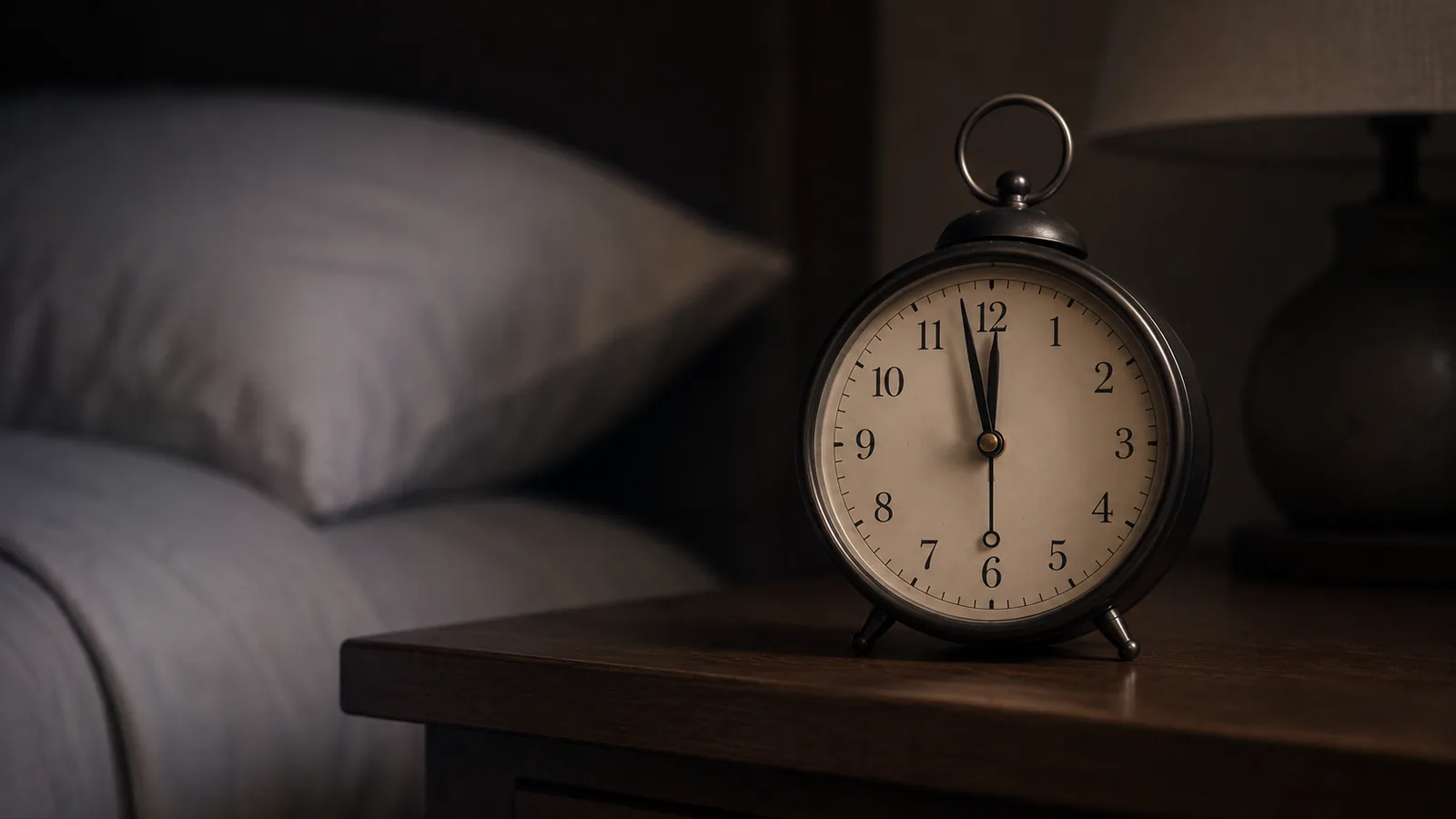
There is a real anticipatory mechanism here: in the best-known experiment, people told they would be woken early showed a rise in the stress hormone ACTH beginning about an hour before that wake time — and no such rise when they expected to sleep in. But the popular version overstates it considerably, and the clock-gene explanation usually attached to it is a garbling of how circadian genes actually work.
This is a case where the underlying finding is genuinely interesting and the retelling has added machinery that was never there.
The experiment
Jan Born and colleagues published a short paper in Nature in 1999 titled "Timing the end of nocturnal sleep." Fifteen participants slept in a laboratory across three nights while blood was sampled through the night for ACTH — the pituitary hormone that drives cortisol release — and cortisol itself.
On some nights participants were told they would be woken at six. On others they were told they could sleep until nine. The manipulation was purely informational: what they had been told before falling asleep.
When participants expected an early wake, ACTH began climbing roughly an hour beforehand. When they expected to sleep in, that early rise did not appear. Later reviews of the cortisol literature have cited this as evidence that manipulating expectancies before sleep can produce an earlier and steeper hormonal rise before waking the next morning.
That is a striking result: an intention formed while awake continuing to shape endocrine activity through hours of unconsciousness, with no external cue.
What is actually doing the anticipating
Your circadian system is not a passive timer that stops at the moment of waking. Body temperature begins rising in the hours before habitual wake time, cortisol climbs steadily through the late portion of the night, and sleep architecture shifts toward lighter stages and more REM. You are already being prepared for waking well before it happens.
Against that steadily rising background, only a small nudge is needed to cross the threshold into wakefulness — which is why waking a few minutes before an alarm is far more plausible than waking spontaneously in the middle of the night at an arbitrary time. The system is not producing an alarm. It is producing a ramp, and you are stepping off the ramp near the top.
This also fits the broader picture of a sleeping brain that continues to monitor and prepare rather than shutting down — the same capability that keeps half your brain on watch during your first night in a hotel.
The clock-gene claim is a garble
Articles on this topic frequently invoke PER proteins — the products of the period genes — as the mechanism, describing them as accumulating overnight until they wake you at the appointed hour. That is not what those genes do.
PER genes are components of the transcription-translation feedback loop that generates the roughly 24-hour rhythm in the first place. Their protein products accumulate, inhibit their own transcription, degrade, and the cycle restarts. This produces a stable oscillation that keeps time across the whole day.
The loop has no access to your alarm setting. It does not know that today's wake time is 6:15 rather than 7:30, and it cannot be reset by an intention formed at bedtime. Clock genes explain why you have a rhythm roughly aligned to your habitual schedule. They do not explain the anticipation effect, which operates on a specific expectation for a specific night — that is an HPA-axis and prospective-memory phenomenon, running on a different timescale and a different system.
Why the confusion is so persistent
Two true things get welded together. Circadian genes really do govern your daily rhythm, and anticipation really does shift pre-waking hormones. Splicing them produces a satisfying story — a molecular alarm clock — that neither finding supports on its own.
How firm is the anticipation finding?
Less firm than its fame implies, and the qualifications matter.
- The original study had fifteen participants and was published as a short communication rather than a full paper.
- It measured a hormonal signature of anticipation, not actual spontaneous waking at the target time. Nobody demonstrated that participants reliably woke before the alarm.
- The wider cortisol-awakening literature it sits inside has been challenged: a 2025 study using ambulatory microdialysis in around 200 people found no change in the rate of cortisol increase in the hour after waking compared with the hour before, questioning how much waking itself drives the rise.
- There is a selection effect in your own experience. You vividly remember the mornings you woke at 6:14 before a 6:15 alarm. You do not count the mornings the alarm woke you from deep sleep, because there was nothing to notice.
None of that makes the effect fictional. It means the accurate claim is narrower than the popular one: expectation demonstrably influences pre-waking hormone levels, on top of a circadian ramp that was preparing you for waking anyway. Whether that reliably produces spontaneous waking a minute before your alarm is not something the evidence establishes.
Why waking before the alarm feels better
There is a practical reason people notice and value these mornings beyond the novelty. Waking near the top of the circadian ramp — from light sleep, with cortisol and body temperature already climbing — produces far less sleep inertia than being pulled out of deep slow-wave sleep by an alarm.
Sleep inertia is the grogginess, slowed reaction time and impaired decision-making that follow abrupt waking, and it can persist for a substantial period after a bad awakening. An alarm has no information about your sleep stage; it fires at a fixed clock time regardless of what your brain is doing. Spontaneous waking, by definition, happens at a moment your own system had already moved toward.
So the experience of waking just before the alarm and feeling unusually clear is not only memorable — it reflects a genuinely different quality of awakening, which is part of why it stands out enough to generate the folk belief in the first place.
Why it is interesting anyway
The genuinely notable part is the persistence of the intention. You decided something before losing consciousness, and that decision measurably shaped your physiology for the next several hours without any conscious involvement.
That is the same broad capacity behind unfinished intentions staying active and intrusive during waking hours — an open goal continuing to influence processing without being deliberately maintained, which is what makes the Zeigarnik effect worth taking seriously even where its details are contested. Here, the goal survives unconsciousness.
Same trick, different system
Why Fingers Wrinkle in Water (It’s Not What You Think)
Frequently asked questions
Two things overlap. Your circadian system already ramps up temperature, cortisol and lighter sleep stages in the hours before habitual waking, and expectation appears to shift pre-waking hormone levels — in one study, ACTH began rising about an hour before an expected early wake.
No, and this is a common garbling. PER genes form part of the feedback loop generating your roughly 24-hour rhythm. That loop has no access to your alarm setting and cannot be reset by an intention formed at bedtime.
The key study had fifteen participants and appeared as a short communication. It measured hormonal anticipation rather than actual spontaneous waking, and the broader cortisol-awakening literature it sits within has recently been challenged by larger work.
A consistent schedule strengthens the circadian ramp that makes waking near a fixed time easier, which is well supported. Whether intention alone produces reliable spontaneous waking at a chosen time has not been demonstrated.
Partly because it does, in a coarse way — the circadian system keeps a stable daily rhythm. But your experience overstates the precision, because mornings you wake just before the alarm are memorable while mornings the alarm wakes you are not.
This article is educational science trivia about everyday human biology and psychology. It is not medical advice, diagnosis, or treatment, and it is not a substitute for care from a qualified professional.