Synesthesia: What It’s Like When Letters Have Colors
For a small minority, the letter A has a colour — and it’s the same colour their whole life.
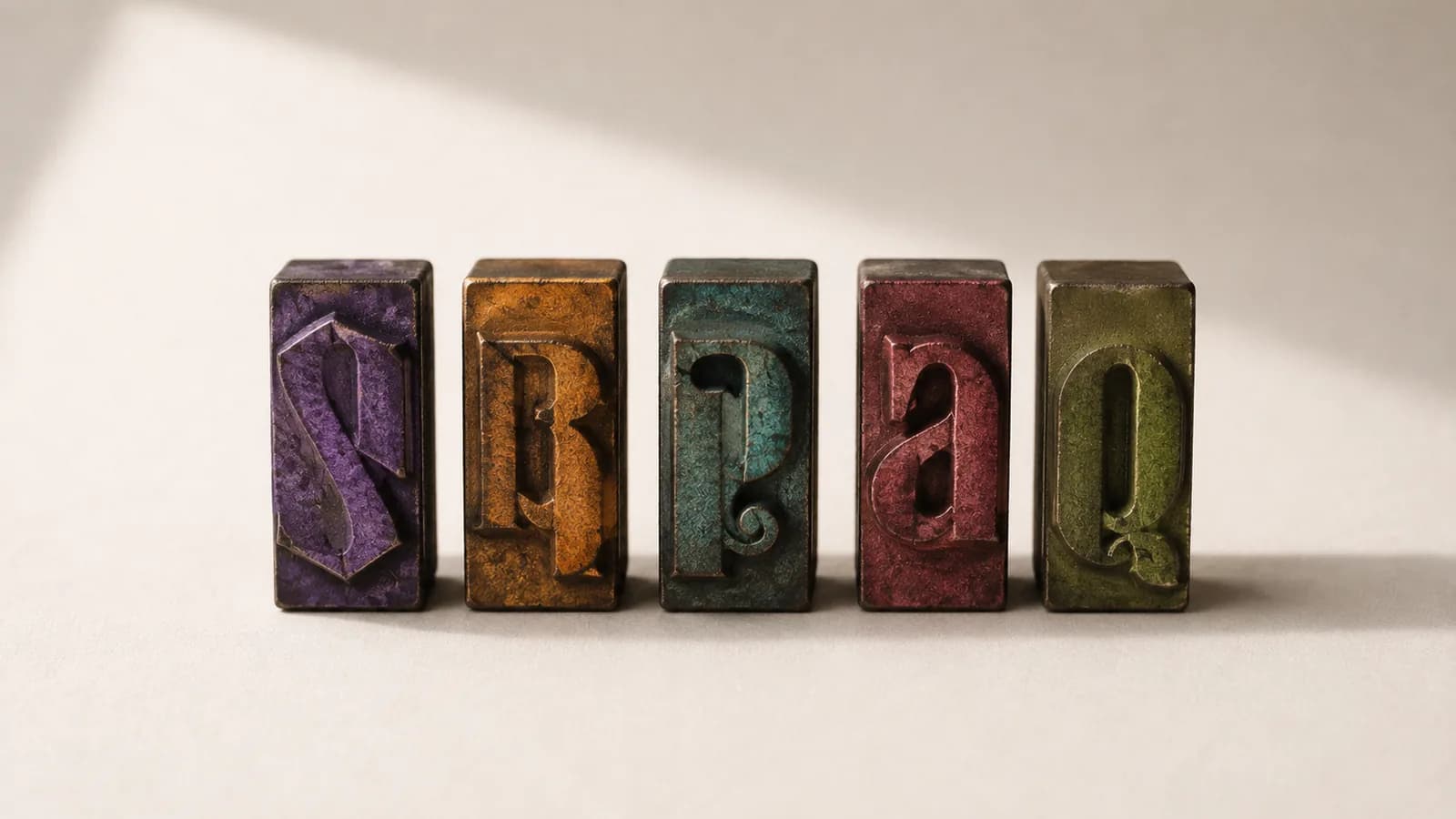
For roughly one to four percent of people, a stimulus in one domain automatically produces an experience in another — most commonly letters and numbers having consistent colours. The pairings are involuntary, and the standard test is consistency: a synesthete gives near-identical colour matches years apart. What is no longer tenable is the tidy story that these pairings are purely innate wiring, because some of them can be traced to childhood toys.
That last finding is one of the more entertaining results in cognitive neuroscience, and it forced a real revision of how the condition is understood.
What synesthesia is
A synesthetic experience has two parts: an inducer, which triggers it, and a concurrent, which is the additional experience produced. In grapheme-colour synesthesia — the most studied form — letters and digits are the inducers and colours the concurrents.
Three properties define it. The pairing is automatic: seeing the letter produces the colour without any choice. It is consistent: the same letter produces the same colour across decades. And it is idiosyncratic: two synesthetes rarely agree on what colour A is, though weak population-level tendencies exist.
Consistency is the diagnostic criterion precisely because it is hard to fake. Asked to match colours to letters and retested without warning months or years later, synesthetes reproduce their choices closely; non-synesthetes asked to invent and remember pairings do far worse.
There is also considerable variation within the population. Some synesthetes perceive the colour as out in the world, overlaying the letter; others experience it as strongly associated but internal. Researchers describe these as projectors and associators, and they may not be the same thing mechanistically.
How common, and it is not what you would guess
Careful prevalence work by Julia Simner and colleagues, using objective consistency testing rather than self-report, puts the overall figure at somewhere between one and four percent, with grapheme-colour synesthesia around one percent.
That is high enough to matter. It rules out treating synesthesia as a rare curiosity, and it means most people know several synesthetes without knowing it — many synesthetes assume everyone experiences the same thing until well into adulthood. It sits with other traits where a minority experience something the majority cannot picture, including the reflex that makes a quarter of people sneeze in sunlight — where, similarly, the early single-gene model has not survived.
How many kinds there are
Grapheme-colour dominates the research literature because it is easy to test, but dozens of forms have been documented and some are considerably stranger.
- Sequence-space: numbers, months or days experienced as occupying specific positions in space around the body.
- Ordinal linguistic personification: letters and numbers having personalities and genders — 7 is arrogant, B is a quiet woman.
- Lexical-gustatory: words producing specific tastes, one of the rarest documented forms.
- Mirror-touch: seeing someone else touched producing a felt touch on one's own body.
- Coloured hearing: sounds, and often music specifically, producing visual colour experiences.
This variety is a problem for any single mechanism, and it is why the neat local-wiring story struggles. Whatever synesthesia is, it appears to be a family of related conditions rather than one thing with several costumes.
It also has a long documented history. Francis Galton described the phenomenon in 1880, including the number-forms now called sequence-space synesthesia, which means the condition was characterised well before there was any means of investigating it.
Two competing mechanisms
The best-known account is cross-activation, proposed by V. S. Ramachandran and Edward Hubbard: grapheme-colour synesthesia arises from direct connections between the brain region processing letter forms and the adjacent colour region V4, which happen to sit close together in the fusiform gyrus. Excess local connectivity, perhaps from incomplete pruning during development, would produce automatic co-activation.
The competing account is disinhibited feedback, from Peter Grossenbacher and Christopher Lovelace: connectivity is normal, but feedback from higher-level areas that would ordinarily be suppressed is not, allowing activity to spread.
Diffusion imaging by Romke Rouw and Steven Scholte found increased structural connectivity in grapheme-colour synesthetes, supporting cross-activation. But a functional connectivity study of auditory-visual synesthetes found no increased connectivity between auditory and visual cortex, and instead stronger connections from inferior parietal cortex to both — evidence for disinhibited feedback rather than cross-activation.
The adjacency argument also weakens outside grapheme-colour synesthesia. Regions handling sound and colour are not neighbours, so a local-wiring account cannot easily explain coloured hearing. Current thinking increasingly involves a parietal binding hub alongside local connectivity — which is less elegant than either original theory and probably closer to right.
The refrigerator magnets
In 2006 Nathan Witthoft and Jonathan Winawer described a synesthete whose letter-colour pairings matched, almost exactly, a set of coloured Fisher-Price refrigerator magnets she had played with as a child.
One case is an anecdote. So they followed it up with a large online sample of synesthetes and found a subset whose pairings matched that same commercially available magnet set — a small but unmistakable proportion of the population, far above chance.
This is a serious constraint on any purely innate account. The specific content of these synesthetic pairings was learned from an object in a childhood kitchen. Related work has also shown that adults can be trained over weeks to acquire consistent, automatic-feeling letter-colour associations, though whether these are the same phenomenon as developmental synesthesia is disputed.
How the field absorbed it
The current view is that what is inherited is a predisposition — a tendency toward this kind of cross-domain binding — while the specific pairings are shaped by whatever the child encountered while learning letters. Genetic work supports the general picture: synesthesia clearly runs in families, but no single gene has been found, and whole-exome studies point to multiple genes rather than a simple inheritance pattern.
What it does not do
Two claims deserve tempering. Synesthetes are often said to have exceptional memory; the studies show modest advantages, mostly confined to material where the synesthetic dimension supplies an extra cue, and they are small. The link to creativity is similarly weaker than its reputation, resting on small samples and self-selection.
Synesthesia is also not a disorder and not associated with impairment. It is a variant form of perception whose owners overwhelmingly report finding it pleasant or neutral — which, on a site full of quirks that mostly cause mild inconvenience, makes it something of an outlier.
Same trick, different system
Happy Tears: Why We Cry When Nothing Is Wrong
Frequently asked questions
A condition in which a stimulus in one domain automatically produces an additional experience in another — most commonly letters and numbers having consistent colours. The pairings are involuntary, stable across decades, and largely idiosyncratic between individuals.
Prevalence work using objective consistency testing puts the overall figure between roughly one and four percent, with grapheme-colour synesthesia around one percent — common enough that most people know synesthetes without realising it.
Both appear to contribute. It runs in families and no single gene has been identified, but some synesthetes' letter-colour pairings match a commercial set of childhood refrigerator magnets — so the predisposition may be inherited while the specific pairings are learned.
The standard method is consistency. Participants match colours to letters and are retested without warning after a long interval; synesthetes reproduce their choices closely while non-synesthetes attempting to memorise pairings perform substantially worse.
Modestly, and less than the reputation suggests. Advantages appear mainly for material where the synesthetic dimension provides an additional retrieval cue, and the supporting studies have generally used small samples.
This article is educational science trivia about everyday human biology and psychology. It is not medical advice, diagnosis, or treatment, and it is not a substitute for care from a qualified professional.