Why Your Eyes Water When You Yawn
The yawn squeezes your tear glands like a sponge. That’s the entire mystery.
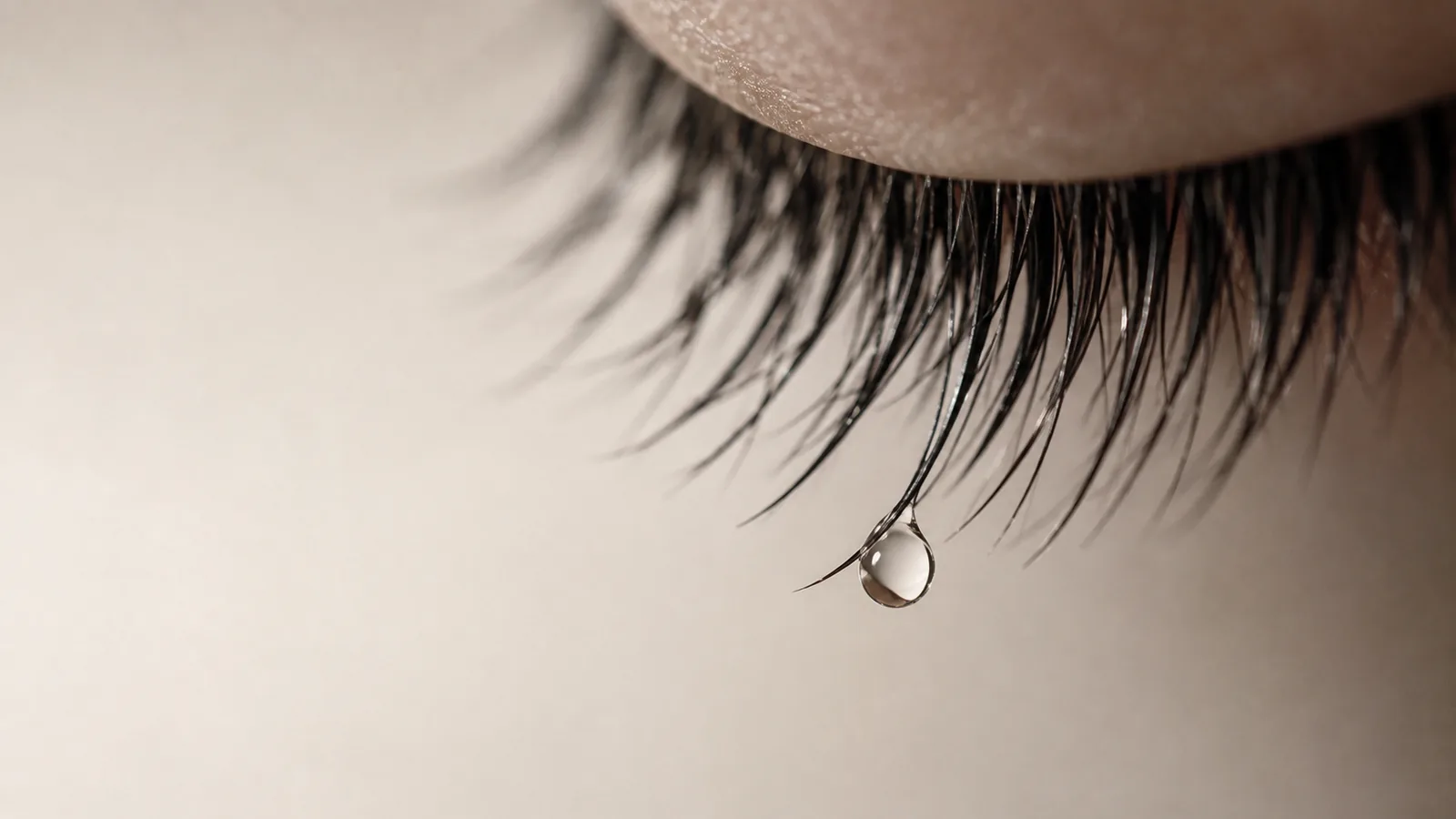
A deep yawn contracts the muscles surrounding your eyes, and those muscles sit directly on the structures that both produce and drain tears. The squeeze pushes existing tear fluid out of the gland while simultaneously obstructing the drainage duct — more coming in, less going out, so the surplus spills. It is mechanical rather than emotional, and the mechanism is inferred from anatomy rather than demonstrated by research.
That final point is worth making early. This is one of the few topics on this site where confident explanations circulate widely and the primary literature is close to nonexistent.
The plumbing
Tears are produced continuously, not only during crying. The lacrimal gland, sitting above and slightly outside each eye under the brow bone, secretes a basal film that keeps the cornea wet and clear. Blinking spreads it across the surface.
Drainage runs the other way. Fluid collects at the inner corner of the eye and passes through two small openings called puncta into the lacrimal canaliculi, then into the lacrimal sac, then down the nasolacrimal duct into the nasal cavity — which is why a heavy cry produces a runny nose. Production and drainage are normally balanced, so nothing spills.
A tear only escapes onto your cheek when that balance breaks: either production increases sharply, or drainage is impeded, or both.
What a yawn does to it
A full yawn is a much more violent facial event than it feels. The jaw opens to near-maximum, and the muscles of facial expression contract hard — particularly orbicularis oculi, the ring of muscle encircling each eye that closes the lids. This is why yawns are usually accompanied by an involuntary squeeze-shut of the eyes rather than a simple blink.
Orbicularis oculi surrounds both the lacrimal gland region and the drainage apparatus. Contracting it compresses the gland, expressing fluid that was already sitting in it, and simultaneously affects the canaliculi and lacrimal sac — the same muscular pump that normally assists drainage, being overwhelmed rather than assisted when the contraction is this forceful and sustained.
The result is a brief mismatch: a bolus of fluid arriving on the eye surface while the exit is compromised. The surplus spills over the lid margin. This also explains the timing, which is worth noticing — the tears appear during or immediately after the yawn's peak, not gradually.
None of it has anything to do with emotion. It is the same output produced by an entirely different route, and the fact that both are called crying is a limitation of the word rather than of the physiology. That distinction becomes clearer if you know how the yawn itself works, and how disputed its function still is.
The three kinds of tears
Ophthalmology distinguishes three, and yawn tears belong squarely to one of them.
- Basal tears: produced continuously, maintaining the tear film that keeps the cornea clear and protected.
- Reflex tears: produced in response to irritation, whether chemical, mechanical or thermal — the flood you get from smoke, wind, or a foreign body.
- Emotional tears: produced in response to emotional states, uniquely human as far as anyone knows.
Yawn tears sit slightly awkwardly across the first two. Nothing is irritating the eye, so no reflex production has been triggered; what is spilling is largely basal tear fluid being mechanically displaced. It is a fourth thing, or a subtype nobody has bothered to name, which is a reasonable indication of how little attention it has received.
The yawn's other side effects
Tearing is not the only thing a yawn does incidentally. The same jaw opening that compresses the eye region also affects the eustachian tubes connecting the middle ear to the throat, which is why yawning frequently produces the ear-popping sensation people deliberately induce on aircraft.
Many people also notice a brief muffling of hearing at the peak of a yawn. This is attributed to contraction of the tensor tympani, a small middle-ear muscle that dampens sound transmission — activated as part of the yawn's motor pattern rather than for any auditory reason.
The pattern is consistent: a yawn is a large, coordinated contraction across the face and jaw, and several structures that happen to sit in the affected region get squeezed along the way. The tearing belongs in that category rather than being a purpose-built feature.
Why only some people, and only some yawns
The variation is real and unexplained. Some people tear at almost every yawn, some occasionally, some never. Deeper and longer yawns produce it more reliably than shallow ones, which fits the mechanical account — a harder squeeze on a fuller gland.
Beyond that, the plausible contributors are anatomical and untested: individual differences in the volume of basal tear production, in the calibre and patency of the drainage ducts, and in how forcefully the orbicularis contracts during a yawn. People with dry eye might be expected to tear less from yawning and people with partially obstructed drainage more, but neither has been studied.
Environment also matters in the obvious direction. A yawn in dry air, or after a long stretch of screen use with reduced blinking, arrives on an eye already working to maintain its film — and a tired eye at the end of the day is both more likely to be yawned and more likely to be marginal on tear balance.
How much of this is actually established?
The anatomy is not in question. The lacrimal gland's position, the drainage route, and the action of orbicularis oculi are all standard, uncontroversial physiology described in any ophthalmology text.
What is missing is anyone having studied the specific phenomenon. There is no body of research measuring tear film changes during yawning, quantifying how much fluid is expressed, or testing why individuals differ. The mechanism given here — and in every other account you will read — is a reasonable deduction from known anatomy rather than a measured finding.
That is a defensible position for a trivial and harmless phenomenon nobody has reason to fund research into. It is worth saying plainly, though, because the confident tone of most explanations implies an evidence base that does not exist. Contrast this with the tears an onion produces, where the chemistry has been worked out down to the specific enzyme and a whole tearless cultivar built on the finding. Same visible outcome, wildly different depths of understanding.
Same trick, different system
Earworms: Why Songs Get Stuck in Your Head (and How They Leave)
Frequently asked questions
A deep yawn contracts the muscles ringing the eye, which compresses the lacrimal gland and expresses tear fluid while simultaneously impeding drainage. More fluid arrives on the eye surface than can drain away, so the surplus spills over.
No. Emotional tears are produced in response to emotional states through a different pathway. Yawn tears are mechanical — largely existing basal tear fluid being squeezed out and prevented from draining, with no additional production triggered.
The variation is real and unexplained. Plausible contributors include individual differences in basal tear volume, drainage duct calibre, and how forcefully the eye muscles contract during a yawn — none of which has been studied.
It appears to. Deeper, longer yawns produce tearing more reliably than shallow ones, which is consistent with a mechanical explanation: a harder muscular squeeze on a gland with more fluid in it.
Very little. The anatomy involved is standard and uncontroversial, but no research appears to have measured tear film changes during yawning specifically. The usual explanation is a deduction from known anatomy rather than a demonstrated finding.
This article is educational science trivia about everyday human biology and psychology. It is not medical advice, diagnosis, or treatment, and it is not a substitute for care from a qualified professional.